Speaker Lucas: The House will Take up Roads Issue After Easter

Speaker Lucas


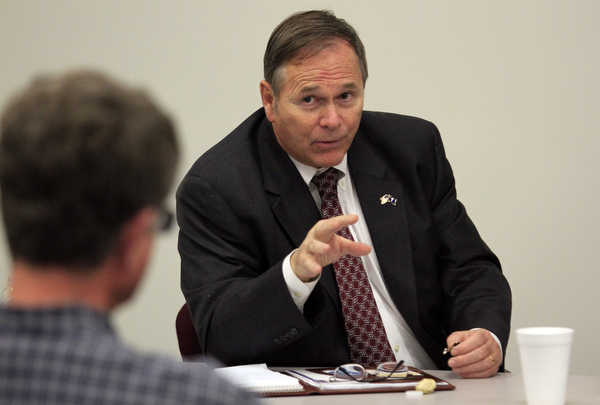
With a proposed $6.9 billion state spending plan out of the way, the S.C. House of Representatives plans to tackle a new road plan for the Palmetto State after the Easter break, Speaker Jay Lucas said Tuesday at the fifth annual TDL Summit in Columbia.

Coming up with a funding remedy for the state’s roads, which the S.C. Department of Transportation estimates are running about $1.5 billion short of cash annually, is an “astronomically huge problem,” said Lucas, R-Hartsville.

Speaking to a roomful of 200 executives from transportation, distribution and logistics companies at the Columbia Metropolitan Convention Center, Lucas said the House will be out of session for a couple of furlough weeks, before and after Easter, before it deals with the roads issue.

On its agenda is the need to sort through bills, including one measure crafted by an ad hoc panel Lucas appointed, and at the same time work with Gov. Nikki Haley’s proposal to raise the gas tax up to 10 cents a gallon in exchange for trimming the state income tax.

Bills in the House aim to raise an additional $400 million a year to fix and maintain South Carolina’s transportation infrastructure.

South Carolina simply has too many miles of roads to take care of, Lucas said.


Read the full article by clicking the link below:

http://gsabusiness.com/news/53993-lucas-expects-house-to-tackle-roads-issue-after-easter

Competing Roads Funding Plans in the SC General Assembly

As the South Carolina House prepares to begin debating how to raise more money to maintain and repair state roads, several other plans are being discussed by a special Senate committee.

While two bills in the House look to raise about $400 million more for roads a year, the Senate appears to want to direct a larger amount to roads.

The Senate also appears less interested than the House and Gov. Nikki Haley in changing the way the South Carolina Department of Transportation operates.

In a report last year, the DOT estimated it needed more than $1 billion extra to get the state’s roads and bridges to good condition.

A special Senate committee is reviewing six bills with four different plans to increase road revenue. Here are highlights of the plans.

Grooms’ Funding Plan

Sen. Larry Grooms has two bills to increase road funding. Both would involve raising the gas tax by 20 cents over a decade, while incrementally cutting the state’s income tax rate 2 percentage points.

He also wants to take 20 percent of any new revenue South Carolina gets each budget year and put it toward roads until 5 percent of the state’s general budget is paying for highways and bridges.

Grooms said his plans will raise much more than the $400 million per year the House and governor seem focused on.

“Four-hundred million dollars doesn’t even buy us any new lane capacity,’’ said Grooms, R-Charleston, at the subcommittee meeting.

Senate Panel proposes a 20 Cent Gas Tax Increase for 5 Years

A Senate panel looking at road funding has agreed to increase the state’s fuel tax by 20 cents over five years and to index it for inflation.

The move came after Senate Transportation Committee Chairman Larry Grooms told the panel that the state’s highway commission has said the state needs $1.4 billion more a year to bring the state’s roads and bridges to good condition.

The 20-cent increase would generate about $700 million, said Grooms and Sen. Ray Cleary, chairman of the panel.

However, it would likely run into opposition by Gov. Nikki Haley, who has said she will approve no more than a 10-cent increase in the gas tax and then only if lawmakers also reduce the income tax rate from 7 to 5 percent and also scrap the current system for a highway commission.

Haley and State Transportation Secretary Janet Oakley have said the roughly $400 million that would be raised in the governor’s plan would preserve the state’s roads.

Cleary started Tuesday’s meeting by saying he had met with the governor who insisted on the tax relief she has proposed as well as making the state Department of Transportation a cabinet agency.

He warned that based upon that conversation, his own roads-funding plan that he believes would raise $950 million is “dead on arrival” and that the Senate should prepare for a veto.

Read the full article by clicking the link below:

http://www.scnow.com/news/state/article_00e04a4a-c791-11e4-8371-cf3d34b723a0.html

Winthrop University’s Misleading Gas Tax Poll Question??


winthrop university


I just graduated from Winthrop University last May, and was privileged to learn from excellent professors I had in the Graduate College of Business. However, I am disappointed the political science division of the College of Arts and Sciences at Winthrop formulated the recent gas tax question which, in my opinion, led a “yes” answer to the poll question – something we were cautioned against in order to get polls that reflect true public opinion and useful results. I question who might have pushed Winthrop to do the gas tax polling, since this was the second poll on the subject and what its geographic area was.

The Winthrop University poll question was:
“There is currently a proposal in the South Carolina Legislature to increase the state gas tax by up to 10 cents a gallon. This would increase the cost of gas in the state, but a gallon of gas in South Carolina would still be cheaper than a gallon of gas in North Carolina or Georgia. The money raised would be restricted to use for infrastructure, such as repairing roads and bridges.”

An earlier poll found that the respondents did NOT favor an increase in the gas tax, but this poll changed the result to a YES, because it said that the gas tax would be cheaper than North Carolina and Georgia. I wonder if drivers in the Midlands or areas not adjoining Georgia or North Carolina care if South Carolina’s gas “would still be cheaper.”

The question failed to mention that North Carolina has the eighth highest gas tax in the nation and Georgia has the 20th highest while South Carolina’s gas tax is almost the lowest in the nation at 47th, according to data from the Tax Foundation.
Read more at http://www.fitsnews.com/2015/03/09/sarah-nuckles-tricky-gas-tax-poll-question/#TpeLwvIXy4u3SFrB.99

Could Senator Cleary’s Gas Tax and Motor Vehicle Tax Hikes be the Solution for Poor SC Roads

sen cleary

South Carolina’s road shortcomings are well recognized but the prospects for a funding solution don’t appear to be generating the necessary enthusiasm in the Legislature.

The issue is getting bogged down with side issues that are likely to delay a funding solution for yet another year. Gov. Nikki Haley, for example, wants a gas tax increase tied to a major cut in the state income tax rate. And she has threatened to veto anything less. It’s almost a guarantee for stalemate.

The Legislature should look to a simple solution — such as that recommended by Sen. Ray Cleary, R-Georgetown. His proposal grasps the essential problem of crumbling infrastructure and doesn’t shy away from applying the necessary remedy.

Sen. Cleary’s plan seeks new revenue from two main sources: an increase in the state gas tax, and an increase in the sales tax for motor vehicles. His bill recognizes that both sources of revenue are long overdue for adjustment.

The state’s gas tax is 16-cents per gallon, and hasn’t been increased for 25 years. It is among the lowest gas taxes in the nation, and the condition of South Carolina roads is testament to the overdue necessity of increasing the primary source of state revenue for transportation.

The DOT puts the cost of necessary improvements at an astronomical $30 billion over the next 25 years. That would require another $1.2 billion a year to bring the transportation system up to par.

At an additional 10-cents per gallon, Sen. Cleary’s gas tax hike wouldn’t solve that mammoth problem, but it would be a start.

So would an adjustment to the preposterously low ceiling for sales taxes on motor vehicles. Buyers pay no more than $300 in sales tax for any auto, which means that the buyer of a used car costing $6,000 pays the same as the purchaser of a $80,000 luxury vehicle. Where’s the logic or equity in that?


Will Governor Haley’s Infrastructure plan have the Same Effect as Act 388?

State lawmakers are finally waking up to the knowledge that the notorious property tax reform law known as Act 388 was ill-conceived and damaging. Unfortunately, it has taken more than eight years, and a worst-case scenario, to bring lawmakers to this much-needed realization.

It should not take that long for legislators to assess the damage and find a way to fix the problem they created. Just as importantly, they should heed the lessons of Act 388 and avoid making the same mistake twice. They should reject Gov. Nikki Haley’s version of the tax swap that would exchange an increase in the gasoline tax for a significant reduction in the state’s income tax.

In a revealing story last Sunday, Greenville News Columbia Bureau reporter Tim Smith reported that the 1-cent sales tax hike in Act 388 never raised the amount of money it needed to in order to offset the reduction in property taxes on owner-occupied homes. Since it was enacted, Act 388 has left an $866 million school-funding shortfall that has been patched largely with money from the General Fund — money that could have gone to fund road improvements, health care or other education needs, particularly in cash-strapped rural school districts.


Read the full article by clicking the link below:

http://www.greenvilleonline.com/story/opinion/editorials/2015/03/07/south-carolina-lawmakers-need-heed-lessons-failed-act-property-tax-reform/24508813/

Sen. Ray Cleary’s Roads Bill to Raise $800 Million a Year

A senator put in charge by his colleagues to find a way to raise more money for South Carolina roads said Tuesday he has a plan that will put up to an additional $800 million for the state’s highways and bridges.

Sen. Ray Cleary’s plan raises the state’s gas tax 10 cents and allows it to continue to increase with inflation. It also raises the sales tax cap on automobile purchases from $300 to $1,400, eliminates dozens of sales tax exemptions and increases the fees for car registrations and drivers’ licenses.

All of his ideas would cost the average driver in South Carolina about an extra $65 per year, said Cleary, a Republican.

“It’s a lot less than that to get a front-end alignment,” said Sen. Joel Lourie, D-Columbia.

Cleary said his bill, which will be filed this week, will net somewhere between $700 million and $800 million a year — about twice the $400 million that plans by the House and Gov. Nikki Haley would raise. Leaders at the Department of Transportation have said $400 million is enough money to keep the state’s roads in their current condition. The DOT has said closer to $1.5 billion a year is needed to get South Carolina roads to good condition by 2040.

It is vital to make sure South Carolina roads get enough money for decades and that’s why his target is so much higher than other plans, Cleary said.

“Do you want us to fix it with a Band-Aid and come back in four years for more, or do you want us to fix it for good?” said Cleary, R-Murrells Inlet.

SCAT President, Don Weaver on SC Senate Bill S. 277

Don Weaver (1)

South Carolinian’s have come to expect affordable and dependable telephone service, whether through their cell phones or conventional land lines.

The Universal Service Fund was originally created to ensure just that. Businesses and residents had access to telephone communication regardless of where they lived. This meant that if a business or individual were located in a high cost or rural area, he or she would still have an equal and affordable opportunity to phone access.

When the USF was established, 20 years ago, landlines were the conventional method of communication. These consumers are now in the minority and mobile phones dominate the landline telephone market by a 4-to-1 ratio.

Today, mobile providers do not pay into the USF, but they rely upon the infrastructure USF creates to ensure access to business and other landlines. In the mobile phone world, “Wireless” is not totally wireless.

In fact, “Wireless mobile calls don’t happen in the cloud. They require a cell tower that transmits your call through landline facilities to a tower nearest the person you’re calling or directly to their landline or VoIP phone. Without land-based networks, wireless mobile phones don’t work,” said Dukes Scott, executive director of the S.C. Office of Regulatory Staff.

South Carolina Senate Bill 277 (S.277) acknowledges that all service providers, including wireless mobile, actually are dependent upon landlines to complete calls and necessitates an equitable restructuring of fees so that all users are paying into the USF.

Most businesses, from hospitals to restaurants and the 911 services, still rely on landlines as their main source of communication. Since only traditional landlines currently pay into the Universal Service Fund, businesses and elderly folks are left to carry the brunt of these costs.

“Companies big and small are paying disproportionately higher landline fees,” says Lewis Gossett, president and CEO of the S.C. Manufacturers Alliance. “Everyone who uses the fund should participate in the fund that makes service available to all South Carolinians.”

Naysayers of S.277 have claimed that this bill creates a new tax, when in fact it does not. The bill simply ensures that service providers, all of whom use the landline service, pay into the USF fund that gives them access to all phone lines. It also freezes the fund at a fourth of the actual size that the General Assembly enabled 20 years ago.

In addition, S277 guarantees that the SC Public Service Commission will not enter into regulation of the now unregulated and competitive mobile wireless market. All of these facts are sound policy reasons why policy leaders should support S277.

Lastly, and most important, as Ppresident of the S.C. Association of Taxpayers, I’ve devoted 25 years to fighting unfair and burdensome tax increases. If this were a tax increase, taxpayer groups would be working overtime to stop it.

But taxpayer groups understand and support tax fairness and equity because it is good public policy, and it ensures that all pay their fair share. While it is complex, this issue demands the serious and honest understanding of our citizens because it goes to the core of a competitive and affordable telecommunications system.
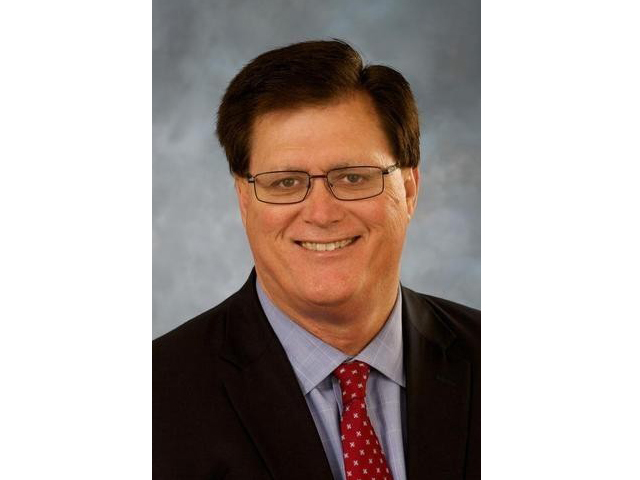
Don Weaver has been president of the S.C. Association of Taxpayers since 1996. The group is comprised of local chapters throughout the state. His email address is drw1220@aol.com


Thank you to thetandd.com for running this press release.

Rep. Horne’s Bill to Bring $1.3 Billion to SC Schools and Roads?

Simplifying how it funds schools and eliminating some sales tax exemptions could pump more than $1 billion into South Carolina’s schools and roads, a Summerville lawmaker said Wednesday.

Unveiling her plan at a news conference, Rep. Jenny Horne, R-Summerville, said the state’s formula for funding schools is overly complex and often shortchanges poor, rural school districts. Horne hopes her plan can gain support in the wake of the state Supreme Court’s recent Abbeville decision.

“The goal of the bill is to simplify funding and put the control in the hands of the school boards and school districts,” Horne said. “It’s the first filed bill that I know of addressing the Abbeville decision.”

The Supreme Court’s November Abbeville decision stems from a 1993 lawsuit when roughly half of the state’s school districts, including Berkeley County, sued the state, saying the Legislature had failed to adequately fund the state’s poor, rural school districts. The Supreme Court sided with the schools and put the onus on the Legislature to find solutions.

Gov. Nikki Haley has proposed raising the average amount spent on students, among other education proposals. House Speaker Jay Lucas has also convened a task force to study the issue and report back the Legislature next year.

Horne’s proposal, called the South Carolina Jobs, Education and Tax Act of 2015, would provide what amounts to a statewide property tax cut in most places on businesses and automobile sales by making property tax rates uniform across the state. To make up for the loss of about $600 million in tax revenues, Horne is proposing eliminating a number of sales tax exemptions that could amount to $2 billion in additional revenue for the state.

Read the full article by clicking the link below:

http://www.postandcourier.com/article/20150304/PC1603/150309727/1031/rep-jenny-horne-offers-plan-to-simplify-increase-education-funding

A Tax Credit for SC Residents facing High Homeowners Insurance Bills

Every year, I’m pleased to see that awareness of a South Carolina tax credit that helps people with high home insurance bills is increasing.

And every year around tax time, I write about the Excess Insurance Premium Tax Credit to help increase awareness, because it’s fair to assume that thousands of people who could benefit still don’t know it exists.

The credit will reduce the amount of money owed in South Carolina income tax, dollar for dollar, up to $1,250. If the cost of insuring your primary residence exceeds 5 percent of your federal adjusted gross income (from your federal tax return), then you qualify.

As tax rules go, that’s about as simple as it gets.

For people living near the coast — the land of soaring insurance bills — even those with relatively high incomes might qualify because coverage is so costly. Homeowners insurance and any additional policies for hurricanes (such as “wind pool” premiums) and flood insurance count when calculating the credit.

Read the full article by clicking the link below: