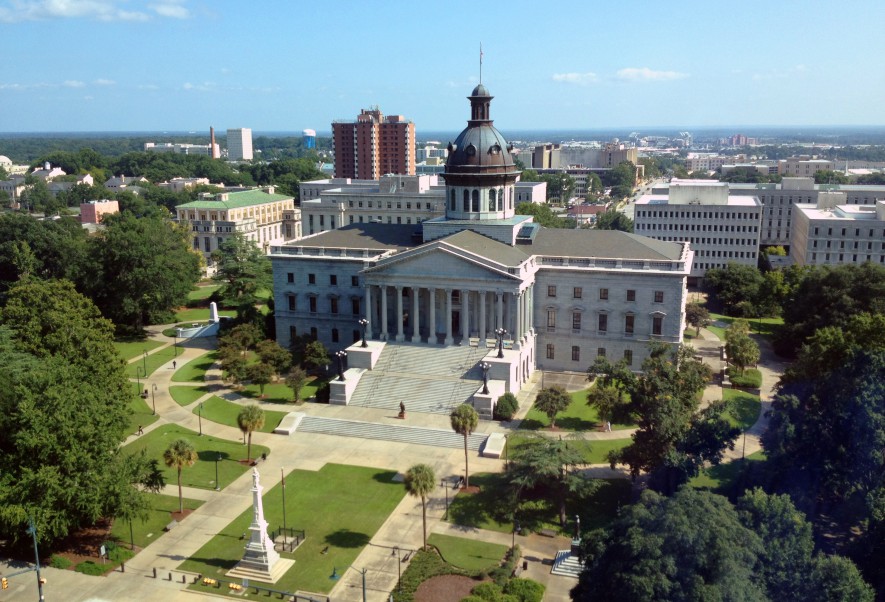
Transportation increases didn’t make the cut in Haley’s proposed Budget

Haley

While remaining cautiously optimistic Haley will unveil her promised fix in Wednesday’s State of the State address, business leaders and transportation officials recently cited a report showing potholes and other road hazards cost South Carolina drivers $3 billion a year and called for raising the state’s gas tax.

“Every day, the cost to maintain our roads is going to continue to rise,” said Bill Ross, executive director of S.C. Alliance to Fix Our Roads. “You’ve got to find a revenue stream for that.”

Haley vowed last year to veto any hike in the state’s gas tax, leading to a rare instance in which a Republican governor taking an anti-tax stand in a conservative state finds herself at odds with chambers of commerce and economic development groups, traditionally among the staunchest opponents of higher taxes. The veto threat also has put her at odds with some lawmakers in her own party, especially in the state Senate, who have said all options for fixing transportation need to be on the table.

The Charleston Metro Chamber of Commerce is among those pressuring lawmakers to raise the state’s nearly 17-cent-per-gallon gas tax, which hasn’t been increased since 1987 and is one of the lowest in the country. President Bryan Derreberry has said the chamber is asking for a 25-cent increase knowing it’s unlikely lawmakers would go that high in hopes of getting a smaller increase.

Haley’s proposed budget elevated education and the troubled Department of Social Services to top priorities, while barely making a dent in the estimated $42 billion shortfall over the next 20 years needed to keep roads and bridges from deteriorating further and improve commutes and travel. Haley’s proposed spending plan allocates all of the money from the sales tax on automobile purchases to transportation, up from the current 50 percent. That would increase funding for the Department of Transportation by $61 million.

It’s a step in the right direction, according to Ted Pitts, president and CEO of the S.C. Chamber of Commerce.

“The business community is clearly speaking with one voice in telling our state leaders we can’t wait any longer on providing adequate funding to maintain and improve our state’s infrastructure,” Pitts said in a statement.

State lawmakers, including some of Haley’s sharpest critics, said they, too, are waiting for Haley to deliver on her campaign promise to lay out a plan for funding transportation maintenance and improvements — estimated at a minimum of $400 million and as high as $1.5 billion a year.
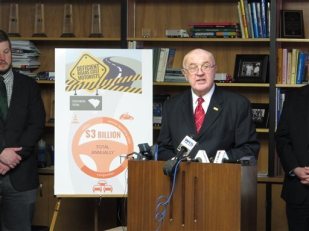
SC DOT Commissioners & Businesses push for more Road Money

Roads

A group called The Road Information Program held news conferences Thursday in several South Carolina cities to release a report that said the average driver in South Carolina pays at least $1,150 extra a year because of extra maintenance, fuel used and the cost of fatal crashes caused by bad roads.

At the news conference in Columbia were four of the state seven Department of Transportation commissioners, who say the state must raise the state’s 16.75-cent-a-gallon gas tax, unchanged for almost 30 years.

“You absolutely cannot maintain the state system with the money we have,” Commissioner John Hardee said.

But a tax increase of any kind is tough to get support for in Republican-dominated South Carolina. Newly-elected commission Chairman Jim Rozier said lawmakers must be willing to break their pledges to reject any tax increase made when the state’s roads weren’t crumbling. The report released Thursday said 46 percent of major South Carolina roads were in poor condition last year, compared to 32 percent in poor condition six years earlier.

Read the full story by clicking the link below:

Senator Grooms legislation to Fix SC Roads

The problem is far too many state officials think they can make up a $30 billion shortfall in road repairs by eliminating waste — ah, they’re doing their greatest hits.

The Department of Transportation budget is about $1.3 billion a year, $500 million of which comes from the federal government with specific instructions on how it is spent. Does anyone really believe they are going to find $600 million of waste in the remaining budget?

Well, anyone with any sense?

Sorry, but this time we’re going to have to use real money.

There are plans to raise the needed revenue — some serious, others laughable — but the best one comes from Lowcountry Sen. Larry Grooms. He wants to phase in a moderate gas tax increase and offset the pain by lowering the state income tax.

The problem?

Well, Grooms makes so much sense that some politicians probably won’t get it.

Pick the lesser poison

South Carolina’s gas tax rates 49th nationally. Only Alaska’s is lower, and since most of their roads are made of snow, they get repaved automatically each year.

The state hasn’t raised its 16.5-cent gas tax since Reagan was president. It is more than a dime cheaper than Georgia’s and 21 cents less than North Carolina’s.

Grooms wants to raise the gas tax by 2 cents a year for 10 years, eventually a 20-cent bump. But at the same time, he wants to cut the state income tax by .2 percent every year, which will lower the 7 percent rate to 5 percent.

That would offset the pain at the pump and shift a significant portion of our road bills to visitors — out-of-state travelers would pay somewhere between 30 percent and 40 percent of that money, depending on whose statistics you use.

This would result in South Carolina having a significantly lower state income tax than either North Carolina (5.8 percent) or Georgia (6 percent).

“This grows the economy,” Grooms says. “When businesses look to relocate, they look at Georgia and North Carolina and see that they have lower income tax rates.”

And a lower income tax is a much better recruiting tool than, say, having the state’s official pastime be “getting a front-end alignment.”

Read the full article by clicking the link below:

http://www.postandcourier.com/article/20150114/PC16/150119753/1005/grooms-wants-to-pave-the-path-to-prosperity-with-a-tax-swap

SC Lawmakers are Divided on how to Fix SC Roads

Lawmakers have yet to get behind a single plan to fix the state’s crumbling roads with just days to go before the legislative session starts.

Legislators said road repairs will be a top priority in 2015 as they addressed the media Thursday, previewing the session.

But an increase to the state’s 16.75 cent-a-gallon gas tax appears to be off the table.

With S.C. gas prices averaging $2.01 Thursday, paying a higher gas tax would not be as great a burden for drivers as a year ago, when gas cost $1.10 a gallon more. But lawmakers are averse to raising the gas tax, in part because Gov. Nikki Haley, R-Lexington, has said she would veto a gas-tax hike.

Lawmakers are divided on how to raise the nearly $43 billion in added money needed for road repairs and expansion through 2040.

That means it may take more than one legislative session to come up with a roads fix, new House Speaker Jay Lucas, R-Darlington, has suggested.

In the S.C. House, a special panel has been studying roads for months.

SC Lawmakers: All Options on the Table to Fix SC Roads


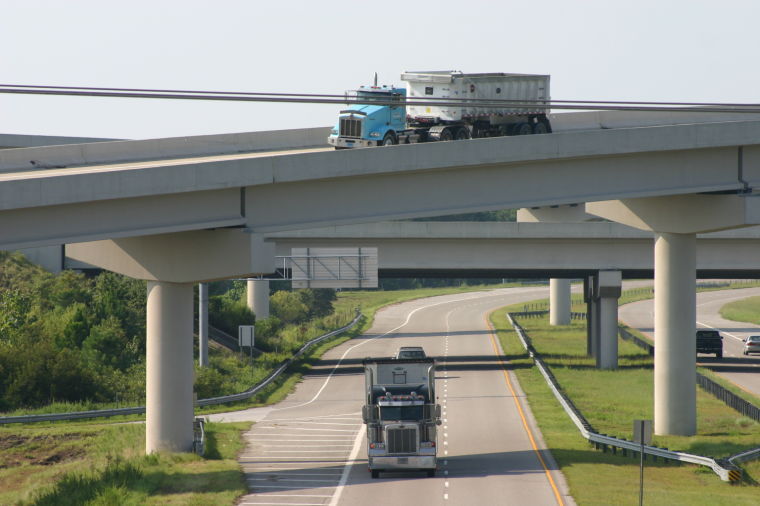
interstate

Some S.C. lawmakers are entertaining the idea of a statewide sales tax to further fund state roads.

But other members of the General Assembly say all options are on the table, from increasing the state’s gas tax to transferring state secondary roads to local government control.

At a legislative briefing with the media Thursday, Rep. Gary Simrill proposed a one-cent sales tax hike, which he said would generate $643 million a year.

Simrill said the tax, which is presently in the discussion stages only, could appear as a state referendum question as early as 2016.

He also hopes to lower the state gas tax by six to eight cents while removing the exemption on wholesale fuel.

Both measures, he said, would be permanent. “The reliance of fuel tax only to pay for roads is a diminishing return,” Simrill said. “We are flat lining in terms of our ability to collect on fuel taxes.”

Read the full story by clicking the link below.

http://www.myhorrynews.com/news/business/article_464aea94-9754-11e4-976c-53aaaff0ddee.html

S.C. Senator Nikki Setzler’s Road Work Plan

If a South Carolina state lawmaker gets his way, hundreds of millions of dollars of funds would be made available to add interstate lanes around the state.

Sen. Nikki Setzler, D-West Columbia, has filed a bill for consideration during the upcoming regular session that would create the Interstate Lane Expansion Fund in the State Infrastructure Bank. Specifically, the bill would use about $60 million annually from vehicle sales taxes to finance constructing new lanes on existing interstates.

Funds could not be used to construct new interstates.

Until 2013, the tax money from vehicle sales was routed entirely to the state’s general fund. Since then, half of the money is used for major work and also for secondary road projects, which aren’t eligible for federal money. Setzler’s plan is to claim the remaining half for lane expansion.

Setzler is one of many state lawmakers who are expected to pursue additional transportation revenue during the five-month session that begins Jan. 13. The lawmakers are acting after the South Carolina Transportation Commission released a projection that the state will need to spend $60 billion during the next 25 years for road work.


– Read the full article by clicking the link below:

http://www.landlinemag.com/Story.aspx?StoryID=28284#.VK6nZCvF9qg

Anderson County Representatives Agree Roads are Key!!

Anderson County’s three longest-tenured legislators agreed Friday that finding money to fix the state’s roads and bridges will be the top task facing the South Carolina General Assembly this year. “The No. 1 issue that is facing us is roads,” said Rep. Brian White, who is chairman of the state House of Representatives Ways and Means Committee. The Republican from Anderson is starting his eighth term.

A report issued by the South Carolina Department of Transportation last year estimated that the state needs to come up with nearly $43 billion in additional money during the next 25 years for maintaining and expanding highways and other transit needs. “We all know it is bad,” White said during the Anderson Area Chamber of Commerce’s monthly Toast N’ Topics breakfast at Tucker’s Restaurant on Clemson Boulevard in Anderson. “It’s an expensive endeavor.”

Raising South Carolina’s 16-cent per gallon gas tax, which is among the nation’s lowest, is one of the road-funding options that will likely be considered when state lawmakers return to the Columbia later this month, White said. But, he cautioned, such a move represents only a partial solution. “Just increasing the gas tax is not going to fix the roads,” White said.

Read the full article here: http://www.thestate.com/2015/01/02/3904866/roads-top-priority-legislators.html#storylink=cpy

SC Legislature “A Year of Problem Solving?”


state flag

Repair crumbling roads

The state Transportation Department estimates it will cost South Carolina $43 billion that the state does not have to repair and expand the state’s roads system through 2040.

While running for re-election, Republican Gov. Nikki Haley promised to unveil her road-repair plan this month. Haley, who opposes increasing the state’s third-lowest-in-the-nation gas tax, will have several high-profile chances to say what she thinks should be done, starting at her Jan. 14 inauguration and, later in the month, in her State of the State speech.

Facing criticism from constituents, legislators also have been studying the issue and meet again Jan. 12 to try to finalize a proposal.

The most recent proposal would give counties the responsibility to repair and maintain nearly half of the roads currently maintained by the state in return for guaranteed state assistance.

County representatives oppose that idea, wary the Legislature will provide enough assistance.

Fix rural schools

After more than two decades of court battles, the state Supreme Court ruled in November that the state has failed in its duty to provide a “minimally adequate” education to children in the state’s poorest school districts.

The court did not order a specific remedy. Instead, it told lawmakers and the school districts to report back with a plan to address a number of issues, including the state’s unconstitutional way of paying for schools, aging facilities and the difficulty in attracting talented teachers to rural areas.

However, Gov. Haley and state lawmakers filed motions with the Supreme Court earlier this week asking for a rehearing of the education lawsuit.

That request could delay what is expected to be a protracted negotiation between lawmakers and poor schools.

Fix Social Services

The embattled state Department of Social Services has been under scrutiny for more than a year with critics saying the agency does not do enough to prevent child deaths. Former director Lillian Koller resigned in July. Last month, Haley named a new agency leader, Clemson official Susan Alford.

Alford must win confirmation from the state Senate.

Meanwhile, Social Services is trying to hire new caseworkers to reduce the number of children its child-welfare workers must oversee. But efforts to increase the number of child-welfare workers have been hurt by high turnover within the agency, as other workers quit.

S.C. Association of Counties to Oppose Road Transfer Legislation

The S.C. Association of Counties completed its Legislative Policy Development process for the 2015 session in December. A complete publication containing the group’s policy positions is being prepared. In a Dec. 17 memo to the Governor, and sent to media outlets, the SCAC Board of Directors said they will likely oppose any legislation that calls for the transferring of roads to local governments and will seek to get the legislature to fully fund the local government fund.

In regards to state infrastructure needs, the SCAC board said that for 50 years the General Assembly adopted a system that included the intake of secondary roads into the state highway system. It is estimated, the memo said, that the percentage of secondary roads in good condition is 10 percent. Counties do not have the financial resources to fund the necessary maintenance costs on the roads within the state system.

Recently passed legislation limiting local governments’ abilities to raise revenues and a failure of the state to provide cost shared revenues have strangled the financial ability for counties to provide minimal services for their constituents. Adding the secondary highway system as a burden on county government and county taxpayers will ensure the financial collapse of many local governments.

Many counties, especially rural counties, have neither the residential nor commercial tax base to assume the perpetual maintenance cost of roads, even if given new revenue sources. Absent a constitutional amendment, no revenue source is safe from the whimsy of a future General Assembly.

For the full story click the link below:

http://www.scnow.com/observer/article_8b5e6a4e-913b-11e4-8426-73bde2000cad.html